Directed Energy Weapons in Future Air Combat: Engineering the Transition Toward Energy-Based Effects
APEX Defense & APEX Autonomous | Published October 1st, 2026
Introduction
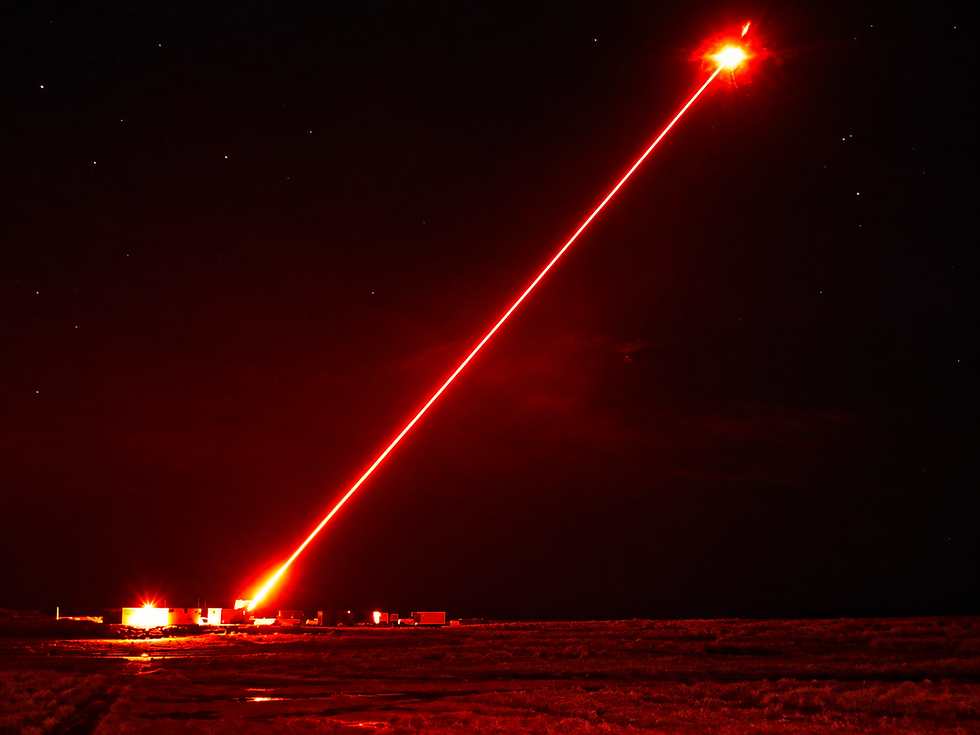
The evolution of air combat has historically been driven by the ability to detect, engage, and defeat threats at increasingly greater ranges and speeds. From mechanically aimed guns to radar-guided missiles and networked precision weapons, each technological generation has expanded the range of possible effects available to the warfighter. Directed Energy Weapons (DEWs) represent a potentially transformative continuation of this progression by replacing conventional stored-energy munitions with systems capable of delivering electromagnetic energy directly toward a target.
At APEX Aerospace, our research examines directed energy not simply as an isolated weapon technology, but as an integrated aerospace subsystem requiring advances in power generation, energy storage, thermal management, beam control, sensing, avionics, and vehicle architecture. The fundamental engineering challenge is therefore considerably broader than generating a high-energy beam. A practical airborne directed-energy system must produce, condition, control, transmit, and dissipate energy within the severe size, weight, power, thermal, and aerodynamic constraints of an aircraft.
The Evolution of Airborne Effects
Conventional aircraft weapons rely upon physical projectiles or energetic materials that must be transported, stored, and eventually replenished. Directed energy introduces a different operational paradigm in which electrical energy can potentially be converted into an effect at the speed of light without requiring a traditional projectile to travel between the aircraft and target.
This creates fundamentally different engineering and logistical considerations. The performance of an energy-based system becomes closely tied to the aircraft’s ability to generate and manage electrical power. As a result, the weapon cannot be separated from the vehicle’s propulsion and electrical architecture. Future aircraft designed around directed energy may therefore require fundamentally different approaches to power generation, distribution, cooling, and energy management.
Power as a Combat Resource
One of the defining challenges of airborne directed energy is the relationship between weapon performance and available electrical power. High-energy systems require substantial instantaneous and sustained electrical output, creating demands that extend well beyond the weapon itself.
APEX research treats electrical power as a strategic vehicle resource that must be dynamically allocated among propulsion, avionics, sensors, communications, electronic warfare, and directed-energy systems. Advanced power electronics, high-density energy storage, solid-state switching, and intelligent power-management architectures could enable future aircraft to distribute electrical energy according to mission requirements.
This creates the possibility of an aircraft in which power allocation becomes an adaptive function of combat operations. Instead of treating each subsystem as having a fixed energy budget, an intelligent power architecture could dynamically prioritize different capabilities according to changing mission conditions.
Thermal Management
Power generation and energy conversion inevitably produce waste heat, making thermal management one of the central limitations of high-energy airborne systems. An aircraft capable of producing significant electrical power must also possess a means of rejecting the resulting thermal energy.
This challenge becomes especially important because aircraft already generate substantial aerodynamic and propulsion-related heat. Adding a high-power directed-energy system can further increase thermal loads throughout the vehicle.
APEX is investigating integrated thermal architectures in which cooling systems are considered simultaneously with power generation and energy conversion. Potential areas of research include advanced heat exchangers, high-temperature materials, thermal storage, regenerative cooling concepts, and distributed heat-rejection systems.
The objective is to move beyond treating thermal management as a secondary subsystem and instead incorporate it into the aircraft’s fundamental architecture from the beginning of the design process.
Beam Generation and Control
The effectiveness of a directed-energy system depends not only on the amount of energy produced but also on the ability to control and direct that energy precisely. Beam-generation technology must therefore be integrated with sophisticated optical, electronic, and control architectures.
A future airborne system may require extremely precise pointing and stabilization while the host aircraft is maneuvering at high speed. Vibration, structural deformation, atmospheric conditions, and platform motion can all influence beam alignment.
APEX research considers beam control as a multidisciplinary problem involving precision mechanics, optical systems, adaptive control, inertial measurement, structural dynamics, and real-time computation. The weapon’s effectiveness ultimately depends upon the ability of the entire aircraft to maintain accurate pointing under operational conditions.
Atmospheric Propagation
Unlike conventional kinetic weapons, directed-energy systems are strongly influenced by the environment through which the energy travels. Atmospheric absorption, scattering, turbulence, humidity, particulates, and other environmental factors can influence propagation characteristics.
Consequently, airborne directed-energy systems must account for atmospheric conditions when determining effective engagement opportunities. Advanced sensing and atmospheric characterization could allow future systems to continuously evaluate environmental conditions and adjust operational parameters accordingly.
APEX research views environmental awareness as an integral component of directed-energy architecture. The same sensor networks supporting aircraft navigation and situational awareness could potentially contribute to evaluating atmospheric conditions relevant to energy transmission.
Sensor Fusion and Precision Tracking
A directed-energy system requires extremely accurate target tracking because its effectiveness depends upon maintaining the energy delivery system on the intended point of interaction. This creates a close relationship between directed energy and the aircraft’s broader sensor architecture.
Radar, electro-optical, infrared, electronic-support, and other sensing technologies can contribute complementary information to a unified tracking solution. Sensor fusion can improve the continuity and confidence of target tracks while reducing dependence on any individual sensor.
APEX research explores architectures in which directed-energy systems are integrated directly into the aircraft’s sensor-fusion framework. Under this model, detection, identification, tracking, engagement assessment, and weapon control become components of a unified information architecture rather than isolated functions.
Adaptive Engagement Architectures
Future aircraft may carry multiple effectors capable of addressing different operational requirements. Directed energy could potentially complement rather than replace conventional weapons, electronic warfare systems, and other non-kinetic capabilities.
An adaptive mission architecture could allow the aircraft to select an appropriate effect based upon factors such as target characteristics, environmental conditions, available energy, mission objectives, and weapon-system status.
APEX research therefore considers directed energy as one component within a broader family of aircraft effects. The future combat aircraft may operate less like a platform carrying a fixed collection of weapons and more like an adaptive effects-management system capable of allocating energy and physical resources according to changing operational requirements.
Integration With Electronic Warfare
Directed energy and electronic warfare represent particularly interesting areas of technological convergence because both rely upon electromagnetic energy rather than conventional kinetic effects.
Future aircraft architectures may integrate sensing, electronic warfare, communications, and directed-energy functions through common power, computing, antenna, and control infrastructure. Such convergence could reduce duplicated hardware while creating opportunities for more efficient use of the aircraft’s electromagnetic and electrical resources.
This concept requires careful systems engineering because combining multiple electromagnetic functions can introduce interference, thermal challenges, and complex control requirements. A unified architecture must therefore be designed around electromagnetic compatibility and predictable system behavior.
Distributed Apertures and Aircraft Integration
The physical integration of a directed-energy system into an aircraft presents significant design challenges. Apertures, optical assemblies, cooling systems, power electronics, and structural components must coexist within an aerodynamic vehicle while preserving performance and survivability.
APEX is examining distributed architectures in which energy-generation, beam-control, sensing, and thermal-management components are integrated throughout the aircraft rather than concentrated into a single subsystem.
This approach could potentially improve packaging flexibility and provide greater architectural resilience. However, distributed systems also increase integration complexity and require sophisticated synchronization between multiple subsystems.
Autonomy and Human–Machine Teaming
The increasing complexity of directed-energy systems creates an opportunity for advanced automation and human–machine collaboration. An autonomous decision-support architecture could continuously monitor power availability, thermal state, tracking quality, atmospheric conditions, and system health while presenting relevant information to the human operator.
Human operators could remain responsible for mission-level decisions while automated systems manage technical optimization and subsystem coordination. This division of responsibility could reduce cognitive workload while allowing the directed-energy system to operate within carefully defined constraints.
APEX research therefore connects directed-energy development with our broader work in Human–Machine Teaming. The weapon system should not exist independently from the pilot or autonomous mission architecture; it should function as part of an integrated human–machine ecosystem.
Survivability and Redundancy
Future aircraft will operate in environments where individual subsystems may experience damage, degradation, or temporary failure. A high-value energy system must therefore incorporate appropriate levels of redundancy and fault tolerance.
Distributed power architectures, redundant sensing, multiple control pathways, health-monitoring systems, and graceful degradation can help maintain aircraft functionality when individual components become unavailable.
APEX research emphasizes designing directed-energy architectures around graceful degradation rather than assuming perfect operation. A system capable of reducing performance while preserving core functionality may provide greater overall mission resilience than one optimized exclusively for maximum peak output.
Digital Engineering and Verification
The complexity of airborne directed-energy systems makes digital engineering essential to their development. Power generation, thermal behavior, structural dynamics, beam control, atmospheric propagation, avionics, and aircraft aerodynamics are tightly coupled and must be analyzed collectively.
APEX is investigating multidisciplinary modeling frameworks capable of representing these interactions throughout the development cycle. Digital twins, computational physics, hardware-in-the-loop testing, and high-fidelity simulation can provide engineers with environments for evaluating system performance before extensive physical testing.
This approach enables designers to identify architectural limitations early and determine how changes in one subsystem influence the rest of the vehicle. Directed-energy development therefore becomes a vehicle-level optimization problem rather than a standalone weapons-development exercise.
The Logistics and Sustainment Advantage
One of the most consequential differences between energy-based and conventional weapons is the potential relationship between weapon availability and the aircraft’s energy infrastructure. Conventional weapons require physical inventory, transportation, loading, and replenishment. An energy-based system instead depends heavily upon the aircraft’s ability to generate and manage electrical power.
This could introduce significant changes in future logistics architectures. However, directed energy does not eliminate logistical requirements. High-power electrical systems, cooling equipment, optical components, power electronics, and other specialized hardware require maintenance and sustainment.
APEX research therefore approaches the potential logistical advantages of directed energy with a systems perspective. The relevant question is not simply whether an energy weapon requires ammunition, but whether the complete aircraft architecture can generate, manage, cool, maintain, and sustain the system efficiently over its operational lifecycle.
Future Air-Combat Architectures
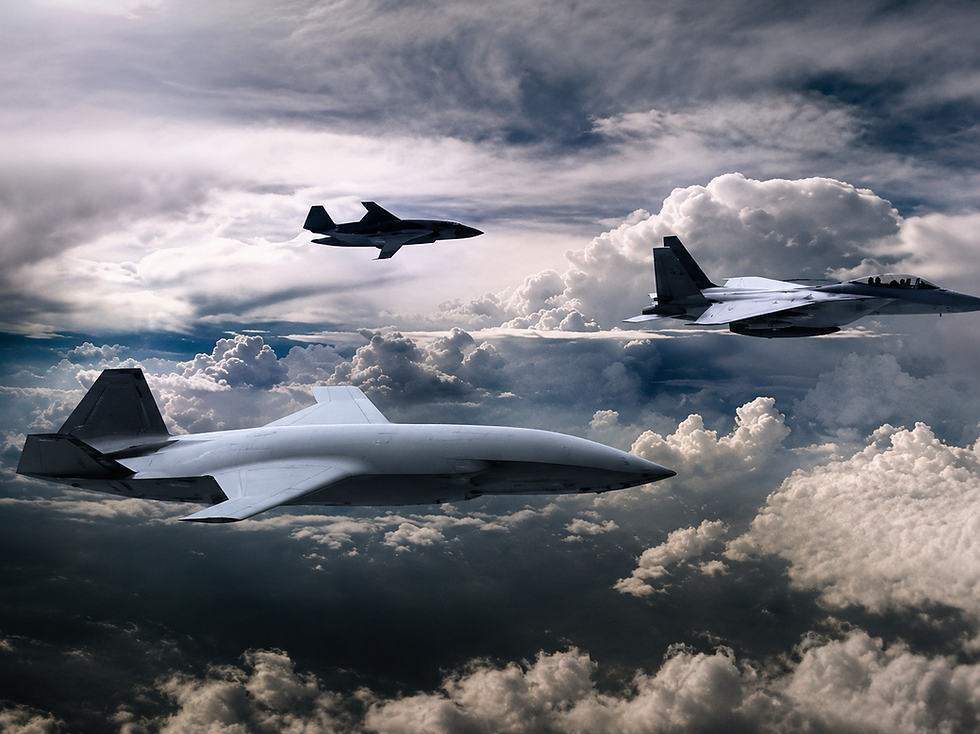
The emergence of directed energy could influence aircraft design at a fundamental level. Future platforms may increasingly be designed around electrical power and thermal capacity as primary performance parameters alongside traditional measures such as speed, range, payload, and maneuverability.
This could accelerate the development of high-capacity electrical architectures, advanced energy storage, adaptive thermal systems, distributed computing, and integrated electromagnetic apertures. Directed energy could consequently influence not only weapons technology but the broader architecture of future combat aircraft.
At APEX Aerospace, we view this possibility as part of a larger transition toward software-defined and energy-centric aerospace systems. Aircraft may increasingly become highly integrated electrical and computational platforms capable of dynamically allocating power, sensing, communications, autonomy, and electromagnetic effects according to mission requirements.
Future Research Directions
Future research in airborne directed energy will likely depend upon simultaneous progress across multiple engineering disciplines. Improvements in power electronics, energy storage, thermal materials, beam-control systems, adaptive optics, sensing, artificial intelligence, and high-temperature aerospace technologies could collectively expand the feasibility of increasingly capable systems.
APEX Aerospace’s continuing research focuses on the architectural problem surrounding these technologies: how can high-energy electromagnetic systems be integrated into an aircraft without compromising propulsion, thermal performance, structural integrity, survivability, or operational flexibility?
Answering this question requires moving beyond individual subsystem optimization toward multidisciplinary engineering frameworks capable of evaluating the aircraft as an integrated energy system.
Conclusion
Directed Energy Weapons represent more than a new category of aircraft armament. They introduce a fundamentally different relationship between weapons, power, thermal management, sensing, computing, and vehicle architecture. The transition from stored physical ammunition toward energy-based effects could fundamentally reshape the engineering priorities of future combat aircraft.
At APEX Aerospace, our research approaches directed energy as an integrated aerospace systems challenge. The development of practical airborne energy systems requires simultaneous advances in electrical power generation, energy storage, thermal management, beam control, sensor fusion, atmospheric characterization, autonomous decision support, structural integration, and digital engineering.
The aircraft of the future may therefore be defined not simply by the weapons it carries, but by its ability to generate, control, distribute, and intelligently employ energy across an integrated combat architecture. Directed energy could become one of the technologies that accelerates this transition—transforming the combat aircraft from a platform that primarily carries energy-based weapons into an intelligent aerospace system capable of generating and managing energy as a fundamental component of its mission capability.


Comments