Active Flow Control Using Plasma Actuators
Updated: Aug 22
APEX Advanced Systems | Published: July 9th, 2026
Introduction
Active flow control has become one of the most promising research areas in modern aerospace engineering, offering innovative methods to manipulate airflow without relying on conventional mechanical control surfaces. As aircraft continue to pursue greater efficiency, improved maneuverability, and reduced radar signatures, engineers have increasingly explored technologies capable of influencing aerodynamic behavior through non-traditional means. Among these emerging technologies, plasma actuators have attracted significant attention due to their ability to modify airflow using electrically generated plasma while introducing virtually no moving parts, minimal weight, and low maintenance requirements. Although still an active area of research, plasma actuators represent a compelling approach for enhancing aerodynamic performance across both military and civilian aerospace applications.
Fundamentals of Plasma Actuators
A plasma actuator typically consists of two electrodes separated by a dielectric material. When a high-voltage alternating current is applied, the surrounding air becomes partially ionized, creating a region of plasma near the exposed electrode. This ionized air experiences an electrohydrodynamic body force that accelerates nearby neutral air molecules, producing a thin wall jet along the surface. Despite generating only modest momentum compared to conventional propulsion systems, this induced airflow is often sufficient to influence the boundary layer, delay flow separation, and alter local aerodynamic characteristics. Because the process is entirely electrical, plasma actuators provide rapid response times measured in milliseconds, enabling real-time aerodynamic control without mechanical complexity.
Boundary Layer Manipulation
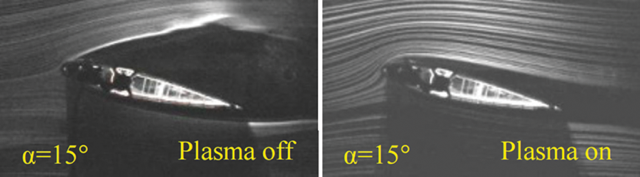
One of the most significant applications of plasma actuators is boundary layer control. The boundary layer is the thin region of airflow directly adjacent to an aircraft’s surface, where viscous effects dominate the flow behavior. Under adverse pressure gradients, this layer can separate from the surface, producing increased drag, reduced lift, and degraded aircraft stability. Plasma actuators inject momentum directly into the boundary layer, energizing slower-moving air and helping it remain attached to the aerodynamic surface for longer periods. By delaying or preventing flow separation, engineers can improve lift generation, reduce aerodynamic losses, and expand the operational envelope of an aircraft during high-angle-of-attack maneuvers.
Aerodynamic Performance Enhancement
The implementation of plasma-based active flow control has demonstrated measurable improvements in aerodynamic efficiency across numerous experimental studies. Wind tunnel testing has shown reductions in pressure drag, increases in maximum lift coefficient, and improved stall characteristics on various airfoil geometries. Because plasma actuators can be activated only when necessary, they consume energy selectively rather than continuously, allowing aircraft to optimize performance during demanding flight conditions such as takeoff, landing, or aggressive maneuvering. Future adaptive flight control systems may integrate arrays of plasma actuators that respond automatically to changing aerodynamic conditions, enabling highly optimized airflow management throughout every phase of flight.
Applications in Military Aviation
Military aircraft present particularly attractive opportunities for plasma actuator integration due to the growing emphasis on stealth, survivability, and maneuverability. Traditional high-lift devices and control surfaces often introduce radar reflections, mechanical complexity, and maintenance requirements. Plasma actuators offer the possibility of supplementing or partially replacing certain aerodynamic functions without altering an aircraft’s external geometry. Research has also investigated their use for reducing infrared signatures through controlled mixing of exhaust gases, mitigating shock-induced separation at transonic speeds, and improving the effectiveness of highly swept or blended wing configurations. Although they are unlikely to replace conventional flight controls entirely, plasma actuators may become valuable components within future low-observable aircraft architectures.
Civil and Commercial Aerospace Applications
Beyond military aviation, plasma actuator technology offers substantial potential within commercial aerospace. Airlines continually seek methods to reduce fuel consumption and greenhouse gas emissions, making aerodynamic efficiency a priority throughout aircraft design. Even modest reductions in drag can produce significant fuel savings over thousands of flight hours. Plasma actuators may improve wing performance during takeoff and landing, reduce wingtip vortex intensity, enhance wind turbine blade efficiency, and improve airflow over unmanned aerial vehicles. Similar concepts have also been investigated for helicopters, high-altitude long-endurance aircraft, and next-generation electric aircraft where maximizing aerodynamic efficiency is essential.
Engineering Challenges
Despite their considerable promise, plasma actuators continue to face several technical limitations that must be addressed before widespread implementation. Current dielectric barrier discharge systems generally produce relatively small body forces, restricting their effectiveness under high-speed flight conditions where aerodynamic forces become substantially greater. Power supply efficiency, thermal management, dielectric material durability, and long-term operational reliability remain active research topics. Environmental factors such as humidity, atmospheric pressure, temperature, and contamination can also influence plasma generation and actuator performance. Developing higher-energy plasma systems while maintaining lightweight, compact, and reliable hardware represents one of the principal engineering challenges facing future commercialization.
Future Research Directions
Continued advances in computational fluid dynamics, high-voltage electronics, advanced dielectric materials, and artificial intelligence are expected to accelerate the development of plasma-based active flow control systems. Researchers are exploring distributed arrays of independently controlled plasma actuators capable of dynamically responding to sensor feedback in real time. Machine learning algorithms may eventually optimize actuator operation by predicting local flow conditions before separation occurs, creating adaptive aerodynamic surfaces that continuously adjust during flight. As electric aircraft architectures mature and onboard electrical power generation becomes more capable, plasma actuators may become increasingly practical for integration into future aerospace platforms.
Conclusion
Active flow control using plasma actuators represents a transformative approach to aerodynamic optimization by manipulating airflow through electrical rather than mechanical means. Their ability to influence the boundary layer, delay flow separation, improve lift characteristics, and reduce aerodynamic drag has made them one of the most actively investigated technologies in contemporary aerospace research. While challenges related to authority, efficiency, durability, and power requirements remain, ongoing developments in materials science, electronics, and computational control continue to expand their practical potential. As aerospace engineering moves toward more intelligent, adaptive, and highly efficient aircraft, plasma actuator technology is poised to play an increasingly important role in the design of next-generation flight systems.

Comments