Human–Machine Teaming in Air Combat: Engineering the Next Generation of Collaborative Combat Aviation
APEX Autonomous | Published: August 27th, 2026

Introduction
The character of air warfare is undergoing a profound transformation driven by advances in artificial intelligence, autonomous systems, distributed sensing, and secure digital networking. Future air superiority will depend not solely on the performance of individual aircraft but on the effectiveness of integrated combat ecosystems capable of coordinating human operators with intelligent autonomous platforms. Human–Machine Teaming (HMT) represents one of the most significant technological developments in modern aerospace engineering, redefining how pilots, autonomous aircraft, and advanced computational systems collaborate to accomplish increasingly complex mission objectives. At APEX Aerospace, our ongoing research investigates engineering frameworks that enable trusted, adaptive, and resilient collaboration between human decision-makers and intelligent autonomous systems operating throughout highly contested battlespaces.
Rather than viewing autonomy as a replacement for human judgment, our research philosophy considers artificial intelligence as a force multiplier that expands human capability through intelligent decision support, rapid information processing, and coordinated autonomous execution. Future combat aviation will increasingly rely upon architectures capable of balancing computational speed with human intuition, producing operational environments where both human and machine contribute complementary strengths toward shared mission success.
The Strategic Evolution of Air Superiority
The evolution of military aviation has consistently been defined by technological breakthroughs that fundamentally altered operational doctrine. Early advances emphasized propulsion, maneuverability, and weapons performance before progressing toward radar integration, stealth technologies, precision-guided munitions, and network-centric warfare. Fifth-generation aircraft introduced unprecedented levels of sensor fusion and battlefield awareness, yet these capabilities simultaneously increased the cognitive demands placed upon pilots responsible for processing enormous volumes of tactical information under severe time constraints.
APEX Aerospace is examining Human–Machine Teaming as the next logical progression in this evolutionary process. Instead of concentrating solely on platform performance, our research explores integrated combat ecosystems where computational intelligence continuously assists human operators by managing information, coordinating autonomous assets, and supporting tactical decision-making. This transition represents a movement from platform-centric warfare toward intelligence-centric operations, where information dominance becomes as strategically valuable as kinetic capability.
Distributed Combat Ecosystems and Collaborative Combat Aircraft
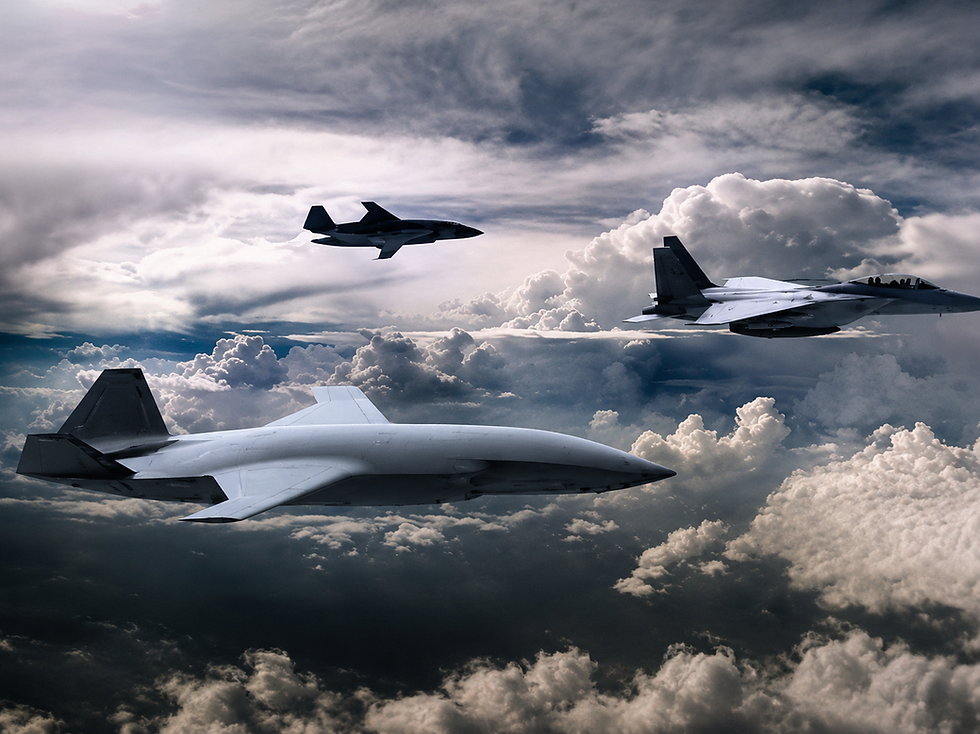
Emerging operational concepts envision future fighter aircraft functioning as command nodes within distributed formations of autonomous collaborative platforms. Rather than conducting missions independently, crewed aircraft may direct multiple autonomous systems capable of reconnaissance, electronic attack, intelligence collection, communications relay, precision strike support, and defensive counter-air operations.
Within APEX, we are investigating system architectures capable of supporting scalable autonomous collaboration through distributed mission management, adaptive task allocation, and decentralized coordination algorithms. These concepts emphasize operational flexibility by allowing autonomous teammates to dynamically redistribute responsibilities as battlefield conditions evolve. Such distributed combat ecosystems possess the potential to increase mission survivability while reducing pilot workload and expanding operational reach across contested theaters.
Artificial Intelligence and Adaptive Decision Advantage
Modern aerial combat unfolds at a pace that increasingly challenges traditional human decision cycles. The continual growth of multispectral sensor networks, electronic warfare systems, cyber operations, and space-based intelligence has created environments where thousands of variables may influence tactical outcomes within seconds.
APEX research focuses on adaptive artificial intelligence capable of transforming vast quantities of operational data into actionable tactical insight. Machine learning algorithms, probabilistic reasoning models, and advanced decision-support architectures are being examined as mechanisms for identifying emerging threats, prioritizing mission objectives, forecasting adversary behavior, and recommending optimal courses of action. Rather than issuing autonomous commands, these systems are intended to augment the pilot’s Observe–Orient–Decide–Act (OODA) loop by reducing cognitive latency while preserving human command authority throughout every stage of mission execution.
Human Factors Engineering and Cognitive Integration
Effective Human–Machine Teaming extends beyond computational performance and depends fundamentally upon the interaction between pilots and intelligent systems. As autonomous capabilities continue expanding, cockpit design must evolve to support intuitive collaboration without introducing additional cognitive burden or operational ambiguity.
APEX Aerospace is actively exploring human-centered interface architectures that incorporate adaptive information management, intelligent workload balancing, augmented reality visualization, natural language interaction, and context-sensitive decision support. These technologies seek to ensure that pilots receive only the most operationally relevant information at precisely the moment it is required, thereby improving situational awareness while minimizing information saturation during high-intensity engagements.
Trustworthy Autonomy and Explainable Artificial Intelligence
Operational trust represents one of the most critical engineering challenges associated with Human–Machine Teaming. Autonomous systems must exhibit predictable behavior across uncertain operational environments while providing sufficient transparency to enable human operators to understand, verify, and, when necessary, override autonomous recommendations.
At APEX, our research investigates explainable artificial intelligence methodologies designed to improve transparency between computational reasoning and human interpretation. Verification frameworks, confidence estimation models, ethical decision architectures, and robust validation methodologies are essential components of developing autonomous systems capable of operating reliably under dynamic combat conditions. Building trust requires not only technical performance but also consistency, interpretability, and demonstrable operational reliability across diverse mission profiles.
Sensor Fusion and Information Dominance
Future combat effectiveness will increasingly depend upon the ability to synthesize information originating from numerous distributed platforms into a unified operational picture. Airborne radar systems, electro-optical sensors, infrared detection systems, electronic support measures, satellite reconnaissance, cyber intelligence, and autonomous reconnaissance assets collectively generate enormous volumes of data requiring rapid interpretation.
APEX research explores advanced sensor fusion architectures capable of integrating heterogeneous information sources into coherent tactical intelligence. Machine-assisted information fusion has the potential to significantly reduce uncertainty, accelerate target identification, improve threat prioritization, and enable coordinated engagement strategies that maximize combat effectiveness while minimizing pilot workload.
Resilient Networks and Mission Continuity
Future conflicts are expected to occur within highly contested electromagnetic environments where communications may become degraded through electronic attack, cyber intrusion, or kinetic disruption. Consequently, Human–Machine Teaming architectures must remain operational despite intermittent connectivity and degraded command networks.
Our investigations emphasize resilient communications, distributed autonomy, secure networking protocols, and decentralized mission execution strategies capable of preserving operational effectiveness during communication denial scenarios. By enabling autonomous systems to interpret commander intent while adapting independently to changing tactical conditions, distributed combat formations may maintain mission continuity even when traditional command structures become temporarily unavailable.
Digital Engineering and Systems Validation
The increasing complexity of autonomous aerospace systems demands equally sophisticated engineering methodologies capable of validating system behavior before operational deployment. Traditional testing approaches alone are insufficient for evaluating intelligent systems whose behaviors continuously evolve in response to dynamic operational environments.
APEX Aerospace is investigating comprehensive digital engineering methodologies incorporating digital twins, high-fidelity simulation environments, hardware-in-the-loop experimentation, mission-level modeling, and systems engineering verification frameworks. These integrated development environments enable rigorous evaluation of autonomous collaboration, human interaction, software reliability, and mission performance prior to physical implementation, substantially reducing technical risk throughout the engineering lifecycle.
Future Research Initiatives
The future of Human–Machine Teaming extends well beyond autonomous flight control. Continued advances in distributed artificial intelligence, adaptive mission planning, resilient autonomy, edge computing, secure communications, multi-domain integration, and collaborative decision architectures will fundamentally reshape the design of next-generation aerospace systems.
APEX Aerospace continues investigating multidisciplinary research initiatives that integrate aerospace engineering, computer science, robotics, human factors engineering, systems engineering, and artificial intelligence into unified operational concepts. Our objective is to contribute foundational engineering research that advances the development of scalable, trustworthy, and operationally effective Human–Machine Teaming technologies capable of supporting future collaborative combat aviation.
Conclusion
Human–Machine Teaming represents a fundamental shift in aerospace engineering, transforming combat aviation from isolated aircraft operations into intelligent, interconnected combat ecosystems. As future operational environments become increasingly complex, success will depend upon the seamless integration of human judgment with computational intelligence, enabling faster decision cycles, improved mission adaptability, enhanced situational awareness, and greater operational resilience. The convergence of artificial intelligence, distributed autonomy, advanced sensor fusion, resilient communications, and human-centered systems engineering will define the next era of air superiority.
At APEX Aerospace, our research is focused on advancing the engineering principles that enable trusted collaboration between human operators and intelligent autonomous systems. Through continued investigation of adaptive autonomy, explainable artificial intelligence, distributed mission architectures, and next-generation aerospace technologies, we seek to contribute toward the development of future combat aviation systems that maximize both human expertise and machine intelligence. We believe that the future of air combat will not be defined by humans or machines operating independently, but by their ability to function as a unified, intelligent, and resilient combat force capable of meeting the demands of tomorrow’s battlespace.

Comments