Morphing Wings for Future Aircraft
Updated: Aug 26
APEX Autonomous & APEX Advanced Systems | Published: August 20th, 2026

Introduction
For more than a century, aircraft have relied on rigid wings with movable control surfaces such as ailerons, flaps, slats, and spoilers to generate lift and maintain stability. While these systems have enabled extraordinary advancements in aviation, they also introduce aerodynamic inefficiencies, structural complexity, and maintenance requirements. As aerospace engineering continues to evolve toward higher efficiency, greater adaptability, and reduced operational costs, morphing wing technology has emerged as one of the most promising innovations for next-generation aircraft. By allowing an aircraft’s wing to physically change its shape during flight, morphing wings have the potential to optimize aerodynamic performance across multiple flight regimes, significantly outperforming conventional fixed-wing designs.
The Principles of Morphing Wing Technology
Morphing wings are adaptive aerodynamic structures capable of continuously altering their geometry to meet changing flight conditions. Unlike traditional wings that depend on hinged control surfaces, morphing wings utilize flexible structures, compliant mechanisms, smart materials, and advanced actuation systems to modify parameters such as camber, span, sweep angle, twist, thickness, and leading-edge profile. These shape changes enable the aircraft to maintain an aerodynamically optimal configuration throughout takeoff, climb, cruise, maneuvering, and landing. By continuously adapting the wing rather than relying on discrete mechanical movements, engineers can reduce drag while maximizing lift and improving overall aerodynamic efficiency.
Smart Materials and Adaptive Structures
One of the keys enabling technologies behind morphing wings is the development of advanced smart materials. Shape memory alloys, piezoelectric actuators, electroactive polymers, and flexible composite laminates allow structural components to change shape while maintaining sufficient strength to withstand aerodynamic loading. Modern composite materials provide high stiffness in critical directions while allowing controlled flexibility where deformation is desired. Combined with embedded sensors and distributed actuation systems, these adaptive structures create wings capable of responding intelligently to aerodynamic forces in real time. This integration of structural engineering, materials science, and control systems represents a major step toward aircraft capable of actively optimizing their own performance during every phase of flight.
Aerodynamic Advantages
The aerodynamic benefits of morphing wings extend well beyond improved lift generation. A continuously optimized wing shape minimizes flow separation, delays stall, reduces induced drag, and improves lift-to-drag ratio across a broad range of airspeeds. During takeoff, increased camber can maximize lift while reducing required runway distance. During cruise, the wing can flatten to minimize drag and fuel consumption. During high-speed maneuvering, adaptive twist distributions can improve roll authority without generating excessive structural loads. Because morphing eliminates many external hinges and gaps associated with conventional control surfaces, airflow remains smoother over the wing, further increasing aerodynamic efficiency while reducing turbulence and aerodynamic noise.
Structural and Mechanical Challenges
Despite their significant advantages, morphing wings present substantial engineering challenges. Aircraft wings must simultaneously remain lightweight, highly flexible, and structurally robust enough to withstand millions of fatigue cycles under varying aerodynamic loads. Designing structures capable of large deformations without sacrificing strength requires innovative internal architectures and advanced finite element modeling. Engineers must also develop reliable actuation systems that are lightweight, energy efficient, and capable of operating under extreme temperatures, vibrations, and pressure changes. Maintaining structural integrity while allowing continuous deformation remains one of the greatest technical obstacles facing widespread implementation of morphing wing technology.
Artificial Intelligence and Autonomous Control
Future morphing wings will likely rely heavily on artificial intelligence and autonomous flight control algorithms. Thousands of embedded sensors distributed throughout the wing can continuously measure pressure distributions, structural strain, airflow characteristics, vibration, and temperature. Machine learning algorithms can process this data in real time, predicting optimal wing configurations based on flight conditions and mission objectives. Rather than responding only to pilot commands, intelligent morphing systems could proactively reshape the wing before atmospheric disturbances occur, improving stability, passenger comfort, and fuel efficiency. This integration of adaptive structures with intelligent control systems represents a significant evolution toward fully autonomous aerodynamic optimization.
Military Applications
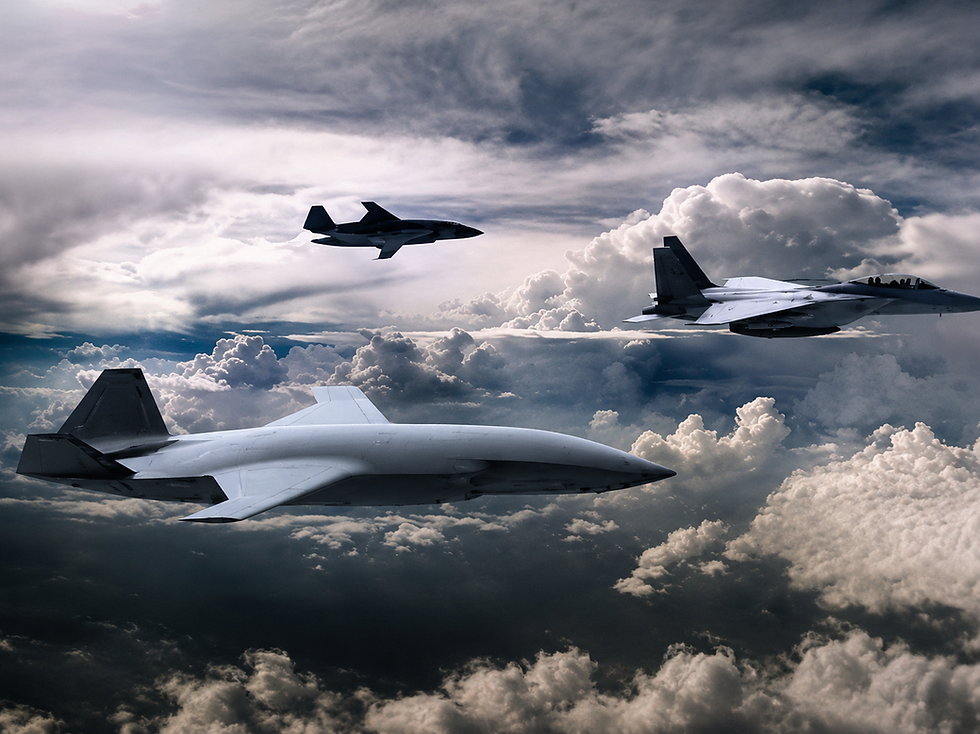
Defense aviation stands to benefit enormously from morphing wing technology. Modern combat aircraft must balance competing performance requirements, including stealth, high-speed interception, low-speed maneuverability, extended range, and payload capacity. A morphing wing could dynamically adjust its sweep angle and camber to optimize each mission phase without relying on mechanically complex variable-sweep mechanisms. Reduced external gaps and control surface discontinuities may also decrease radar reflections, improving stealth characteristics. Additionally, adaptive wings could enhance survivability by redistributing aerodynamic loads during high-G maneuvers while improving fuel efficiency during long-range deployments. Future unmanned combat aircraft may particularly benefit from morphing designs due to their ability to execute highly dynamic flight profiles without human physiological limitations.
Commercial Aviation Applications
Commercial aviation could experience substantial economic and environmental improvements through the adoption of morphing wings. Airlines continually seek methods for reducing fuel consumption, maintenance costs, and greenhouse gas emissions while increasing passenger comfort. Adaptive wings capable of optimizing lift and drag throughout every stage of flight could reduce fuel usage by several percentage points, resulting in significant cost savings across large fleets. Morphing structures may also reduce turbulence-induced vibrations, create smoother flights and lower structural fatigue over the aircraft’s operational lifespan. As sustainable aviation becomes an increasingly important global objective, morphing wing technology offers a promising pathway toward cleaner and more efficient air transportation.
Future Research and Development
Although significant progress has been made in laboratory testing and experimental flight demonstrations, widespread implementation of morphing wings will require continued research in several disciplines. Engineers must develop more durable smart materials, improve actuator efficiency, enhance computational control systems, and refine manufacturing techniques capable of producing highly adaptive structures at commercial scale. Advances in additive manufacturing, digital twins, structural health monitoring, and bio-inspired engineering are expected to accelerate development over the coming decades. Many future aircraft may incorporate partially morphing structures before eventually transitioning toward fully adaptive aerodynamic systems capable of continuously optimizing their geometry throughout an entire mission.
Conclusion
Morphing wing technology represents one of the most transformative advancements in modern aerospace engineering. By replacing rigid aerodynamic surfaces with intelligent, adaptive structures, future aircraft can achieve greater efficiency, enhanced maneuverability, reduced fuel consumption, improved stealth characteristics, and increased operational flexibility. Although numerous engineering challenges remain—including structural durability, material limitations, and autonomous control integration—ongoing advances in smart materials, artificial intelligence, computational modeling, and advanced manufacturing continue to move morphing wings closer to practical implementation. As aerospace technology progresses toward increasingly intelligent and adaptive systems, morphing wings are poised to become a defining feature of the next generation of military, commercial, and unmanned aircraft, fundamentally reshaping the future of flight.

Comments